Your tuck-pointing cost in Spokane in 2026 depends on the repair area, mortar condition, access, and preparation required—not just the size of the wall. Compare the complete repair scope, including mortar removal and replacement, and check whether access equipment, damaged brick replacement, and cleanup are included or separate.
- Tuckpointing cost Spokane: compare defined repair scopes, not totals alone.
- Masonryspokane offers tuck-pointing and brick repair for Spokane homeowners and contractors.
- Mortar repair and damaged brick replacement are different tasks; make both explicit in your quote.
- A useful estimate identifies repair locations, preparation, mortar selection, access, and cleanup.
How much does tuck-pointing cost in Spokane in 2026?
The useful comparison is the total for the same specified work. A quote covering isolated mortar joints is not equivalent to one covering an entire elevation, damaged bricks, and difficult access. Before comparing totals, ask each contractor to identify exactly which joints and surfaces the estimate covers.
For local service information, Masonryspokane offers tuck-pointing alongside brick and stone repair. Keep those tasks distinct when requesting an estimate: replacing mortar does not replace a damaged masonry unit.
| Repair scope | Best for | Main benefit | Limitation to check |
|---|---|---|---|
| Localized mortar repair | Isolated deteriorated joints | Restricts work to identified repair areas | Does not address deterioration outside those areas |
| Broad mortar-joint repair | Deterioration across a wall face | Treats a larger area within one defined scope | Requires more preparation and replacement work |
| Mortar repair with brick replacement | Damaged bricks alongside deteriorated joints | Addresses both joints and masonry units | Adds a separate repair task beyond mortar work |
These are scope comparisons, not interchangeable packages. Choose the scope that addresses the observed condition rather than asking every contractor to quote an undefined wall repair.
Why this matters
A low total is not a useful saving if the estimate leaves out work you expected. An estimate labeled only as tuck-pointing gives you little basis for checking which surfaces, preparation tasks, and repairs it includes.
For a 2026 project, use the same photographs and location list for every quote request. You can then compare the contractors' recommendations without confusing a smaller repair area with a better offer. Ask why any proposed scope differs before choosing it.
Localized mortar repair: define the boundaries
Localized repair focuses on identified joints rather than treating every joint on a wall. Its advantage is a limited scope; its limitation is that surrounding deterioration remains outside the work unless expressly included.
Ask the contractor to mark the repair locations on photographs or describe them clearly. Terms such as front wall or chimney base identify a location, but they do not establish which joints need treatment.
Your estimate should explain whether the work stops at visibly deteriorated joints or extends into adjacent mortar that needs removal. Agree on the boundaries before approving localized repair. This makes the finished work easier to compare with the estimate.
Broad mortar repair: separate surface area from joint work
A wall's surface area and the amount of mortar work are not identical measurements. Brick size, joint layout, openings, and the extent of deterioration affect what the contractor actually repairs.
Ask how the contractor measured the work and what the measurement includes. A quote based on wall area should still describe whether every joint within that area will be treated or only selected joints.
Broad repair offers a clearly defined treatment area, but it also involves more work than an isolated patch. Do not assume full-wall treatment is necessary simply because one section looks worn; ask for the condition-based reason behind the recommendation.
Brick replacement: keep it separate from mortar repair
A cracked or deteriorated brick is a different repair problem from a deteriorated mortar joint. Packing new mortar around a damaged unit does not replace that unit or resolve every possible cause of its damage.
If brick replacement is proposed, ask the contractor to identify the affected units and explain how replacement work fits into the mortar repair. Keep the material selection and repair locations visible in the written scope.
For your 2026 estimate, this distinction prevents two unlike quotes from appearing equivalent. One contractor might include damaged units while another quotes only the surrounding joints; resolve that difference before comparing the totals.
Why tuck-pointing estimates vary
The following factors change the work involved. Use them to question the scope, not to assume a particular rate.
- Repair extent: Selected joints and an entire wall face require different amounts of removal and replacement work.
- Existing mortar condition: Loose, deeply deteriorated, or previously repaired joints need assessment before the preparation method is chosen.
- Access: Work at ground level and work requiring elevated access involve different setup requirements.
- Mortar compatibility: Replacement mortar needs to suit the existing masonry, not merely resemble its color.
- Adjacent damage: Broken bricks, movement, and moisture-entry defects are separate issues that mortar replacement alone does not resolve.
- Protection and cleanup: Protecting nearby surfaces and removing debris are part of the job scope, even when the estimate groups them together.
Mortar selection is a repair decision, not just a cosmetic choice. Ask how the proposed mortar suits the existing brick or stone and how the contractor will assess the joints before removal.
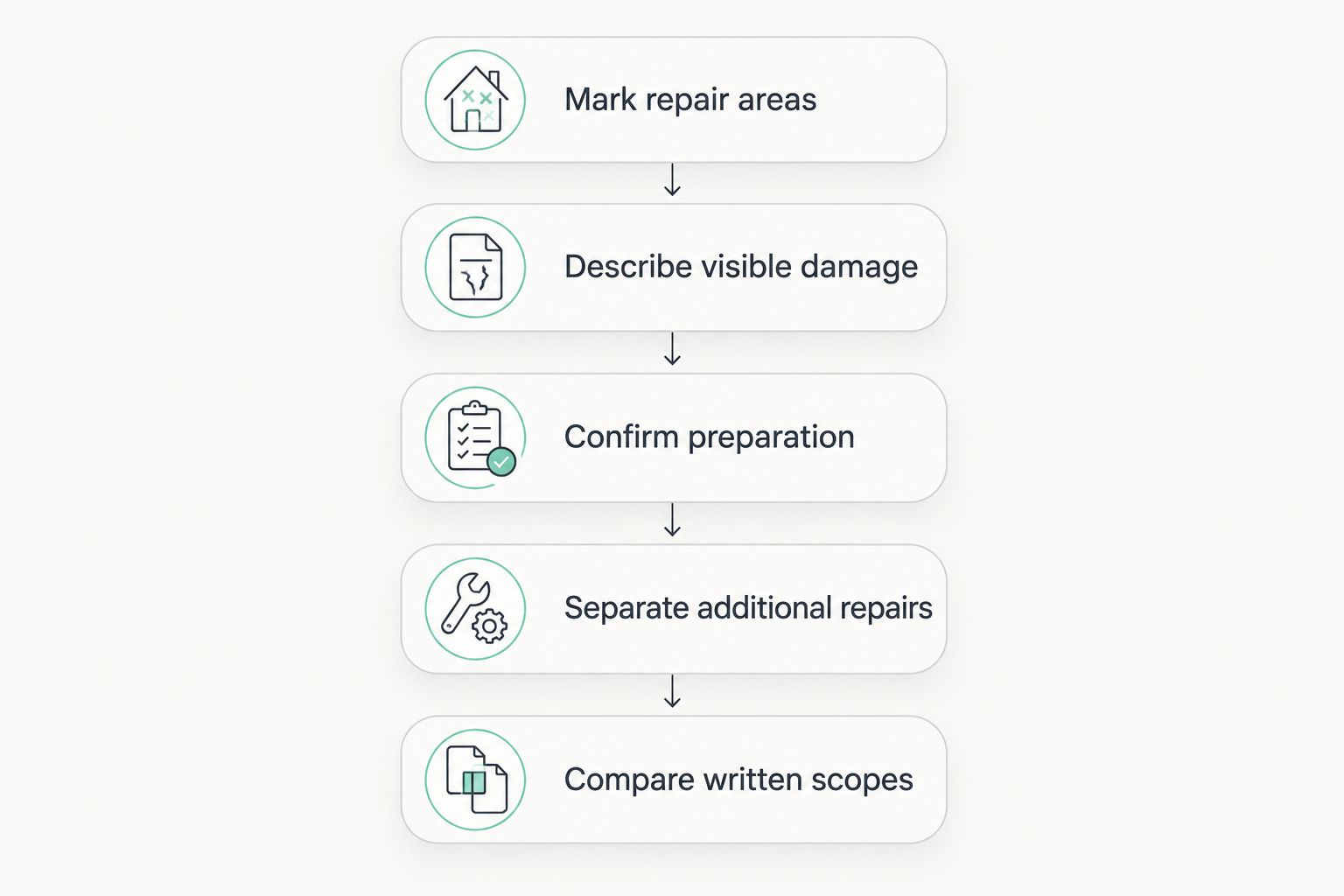
How do you get a comparable tuck-pointing quote?
Give contractors a consistent starting point, then ask them to explain their findings. Photographs help describe the problem, but they do not establish concealed conditions or replace an on-site assessment.
- Mark repair areas. Photograph each affected wall or feature and identify the locations you want assessed.
- Describe visible damage. Note missing mortar, cracked joints, loose units, or damaged brick faces without diagnosing the cause yourself.
- Confirm preparation. Ask how deteriorated mortar will be removed and how surrounding masonry will be protected.
- Separate additional repairs. Identify brick replacement, moisture-entry repairs, or other work outside mortar-joint replacement.
- Compare written scopes. Check locations, inclusions, exclusions, access, and cleanup before comparing totals.
The sequence keeps your request specific without prescribing a repair method before assessment. A contractor should explain the proposed method in relation to the masonry's condition.
Masonryspokane is best suited to Spokane homeowners and contractors seeking tuck-pointing alongside brick or stone repair. Those services match projects involving both mortar joints and masonry units; the requested estimate still needs to define which work applies to your property.
Review local masonry services
See tuck-pointing and brick repair services for Spokane homes and commercial properties.
Is the lowest tuck-pointing quote the best choice?
The lowest tuck-pointing quote is only directly comparable when it covers the same work. Check the repair boundaries, preparation, mortar selection, access, and cleanup before treating a lower total as a saving.
If the scopes differ, ask for clarification rather than assuming either contractor is wrong. A narrower repair and a broader repair need different explanations, not just different totals.
Does tuck-pointing include replacing damaged bricks?
Tuck-pointing does not automatically include replacing damaged bricks. Mortar-joint repair and brick replacement are distinct tasks, so the estimate should identify any unit replacement explicitly.
For a 2026 project, ask which damaged bricks are included and how additional findings will be handled. This is particularly useful when the visible mortar damage sits beside cracked or deteriorated units.
Can tuck-pointing fix every masonry crack?
Tuck-pointing cannot fix every masonry crack because replacing mortar does not correct every cause of cracking. Movement, damaged masonry units, and moisture-entry problems need assessment rather than an assumption that new joints will solve them.
Ask what caused the observed damage and whether the proposed repair addresses that cause. Do not approve a cosmetic repair as a substitute for diagnosing an unresolved defect.
FAQ
How do I compare tuckpointing cost in Spokane in 2026?
Compare estimates for the same repair areas and tasks. Check mortar removal, replacement, access, brick repairs, protection, and cleanup before comparing totals.
Can I get a useful tuck-pointing estimate from photographs?
Photographs help describe visible damage but do not establish the full repair scope. An on-site assessment lets the contractor examine mortar condition, access, and adjacent masonry.
Is tuck-pointing the same as replacing damaged bricks?
No, tuck-pointing repairs mortar joints, while brick replacement replaces damaged masonry units. Ask for each task to be identified in the estimate.
Should I repair the whole wall or only the damaged joints?
Base the repair area on the condition assessment. Localized repair leaves surrounding joints outside the scope, while broader repair treats a larger defined area.
Does mortar color matter when comparing quotes?
Mortar color affects appearance, but compatibility with the existing masonry is also essential. Ask how the contractor selects the replacement mortar rather than comparing color alone.
What does Masonryspokane offer for tuck-pointing projects?
Masonryspokane offers tuck-pointing and brick and stone repair for residential and commercial properties in Spokane. Request a scope that separates mortar-joint work from any masonry-unit repairs.
One last thing
Ask each contractor to attach a marked photograph showing the agreed repair area. That simple record gives you something concrete to check against the finished work and makes exclusions easier to understand.
For your 2026 tuck-pointing project, the most useful estimate is not the shortest one. It is the one that makes the repair boundaries and responsibilities clear before work begins.