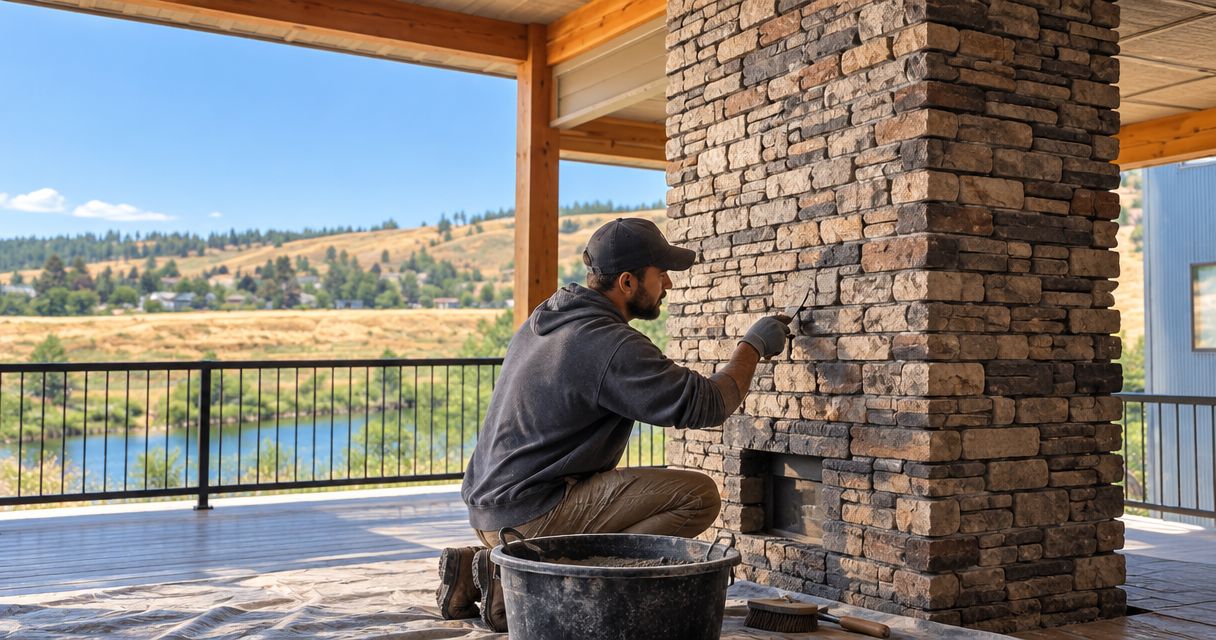
A Spokane chimney needs repair rather than rebuilding when the remaining masonry is stable and the damage is confined to mortar joints, individual bricks, or other repairable components. Rebuilding is the appropriate scope when damaged sections cannot remain safely in place; the decision must also account for the flue, water entry, and connections to the building, not just the visible brickwork.
- Chimney repair Spokane decisions start with masonry stability, not the appearance of one cracked joint.
- Repair localized damage; rebuild sections that cannot support a sound repair.
- Masonryspokane chimney repair services fit builders seeking brick repairs and mortar restoration in Spokane.
- Require separate findings for exterior masonry, water entry, and flue condition before approving the scope.
When does a Spokane chimney need repair rather than rebuilding?
Repair is the right scope when sound masonry can remain; rebuilding is the right scope when it cannot. For a builder planning a 2026 project, that distinction belongs in the inspection findings and bid, not in an assumption made from ground-level photographs.
Use a Masonryspokane project-scope discussion to address the masonry work. Keep chimney operation and flue condition as separate assessment items: an exterior repair does not establish that a fireplace is safe to use.
| Scope | Best for | Main benefit | Main limitation |
|---|---|---|---|
| Localized repair | Sound chimney masonry with isolated joint or brick damage | Retains masonry that remains serviceable | Does not correct instability elsewhere in the chimney |
| Partial rebuilding | A damaged section above masonry confirmed suitable to remain | Replaces the failed section without removing every course | Requires a clearly defined transition to sound masonry |
| Full rebuilding | Widespread deterioration or instability that prevents retaining the chimney structure | Allows the failed structure to be replaced | Requires a broader demolition, construction, and coordination scope |
These are scope categories, not diagnoses. A missing mortar joint alone does not justify a full rebuild, and a straight-looking chimney does not prove that its concealed parts are sound.
Why this matters
A chimney sits at the intersection of masonry, roofing, and fireplace operation. If the bid addresses only what is easiest to see, the general contractor inherits the unresolved work: roof detailing, flue questions, finish protection, or demolition boundaries.
For your 2026 bid package, identify who assesses each part and who completes each repair. Do not approve a masonry-only proposal as a complete chimney solution unless the remaining responsibilities are explicitly assigned.
That approach also makes competing bids readable. A proposal to replace selected bricks is not equivalent to one that removes the upper chimney, even if both are described as chimney repair.
Localized repair: retain masonry that remains sound
Localized chimney repair fits a stable chimney with a defined defect. Examples include deteriorated mortar joints, isolated damaged bricks, or a cracked crown where the surrounding construction is suitable to remain.
The inspection must distinguish between damaged mortar and damaged masonry units. Repointing replaces deteriorated joint mortar; it does not restore the body of a brick whose face has broken away. Specify brick replacement separately when the units themselves have failed.
For mortar restoration, ask the subcontractor to address compatibility with the existing masonry. Mortar selection is not simply a color decision. The repair needs to suit the brick and existing assembly rather than impose a generic mix on every chimney.
Your repair scope should identify:
- The locations and extent of joint restoration.
- Which bricks require replacement rather than joint work.
- Whether the crown needs repair or replacement.
- How adjoining roof details will be protected and coordinated.
- What happens if opening the work reveals additional deterioration.
The advantage is focused work that leaves sound construction in place. The limitation is equally clear: localized repairs cannot compensate for loose courses, displaced masonry, or an unresolved source of water entry.
Choose localized repair only after the inspection identifies what is sound enough to retain. A neat mortar finish is not evidence that the underlying chimney is stable.
Partial rebuilding: replace the failed section
Partial rebuilding fits a chimney where a damaged section can be removed down to masonry confirmed suitable to remain. An upper section with deteriorated brickwork does not automatically require demolition of the entire chimney below it.
The critical question is where removal stops. A bid that says rebuild above the roof needs to explain whether the retained masonry at that level is sound, how the new work connects to it, and what further removal requires authorization.
For a 2026 construction schedule, make that inspection point visible. The general contractor needs to know when the subcontractor will confirm the retained base and when adjoining trades can proceed.
Partial rebuilding also requires decisions about the completed chimney. Address the crown, termination, flashing interface, and relationship to the existing flue as part of the scope. Replacing the outer brickwork does not automatically replace or repair the flue.
The benefit is a defined replacement area. The drawback is the interface between old and new construction, which needs more attention than a vague instruction to match the existing brick.
Approve partial rebuilding when the retained section has been assessed and the demolition boundary is written down. Do not make a roofline an automatic stopping point merely because it is convenient for estimating.
Full rebuilding: replace masonry that cannot remain
Full rebuilding is appropriate when the chimney's condition prevents a sound repair or a sound transition to retained masonry. Leaning, separation, loose construction, and widespread deterioration require assessment of stability, not a cosmetic mortar proposal.
A full-rebuild bid needs to define what full means. Does removal include only the exterior chimney stack, or does it extend into the building? Which supports, flue components, roof openings, and interior finishes are included?
Where the assessment identifies a structural concern, establish whether engineering input is needed before demolition. Do not ask the masonry subcontractor to price around an unresolved support condition and treat that allowance as a complete design.
The advantage of rebuilding is that failed construction does not have to remain as the basis for new work. The limitation is the wider handoff: demolition, weather protection, rebuilding, roofing, and any required chimney-system work must fit together.
Choose full rebuilding because the condition requires it, not because the chimney looks old. Age and appearance alone do not define the repair boundary.
Why chimney repair scope varies
For chimney repair in Spokane, the scope follows the condition of the assembly and the responsibilities included in the contract. These factors explain why apparently similar chimneys receive different proposals:
- Masonry stability: Loose, displaced, or leaning construction changes the decision from surface restoration to assessing what can remain.
- Damage extent: Isolated failed joints require a different scope from deterioration across bricks and multiple sections.
- Water entry: Crown defects, open joints, and roof-interface problems need separate findings and assigned repairs.
- Mortar compatibility: Existing brick and mortar conditions influence the restoration approach; appearance alone is not enough.
- Flue condition: Exterior masonry repairs and flue repairs are different tasks, even when they belong to the same project.
- Access and coordination: Roof access, occupied areas, demolition protection, and adjoining trades affect how the work is organized.
None of these factors establishes a price or completion date by itself. They establish what the subcontractor must inspect, describe, and coordinate before you approve the work.
How should a general contractor define the repair scope?
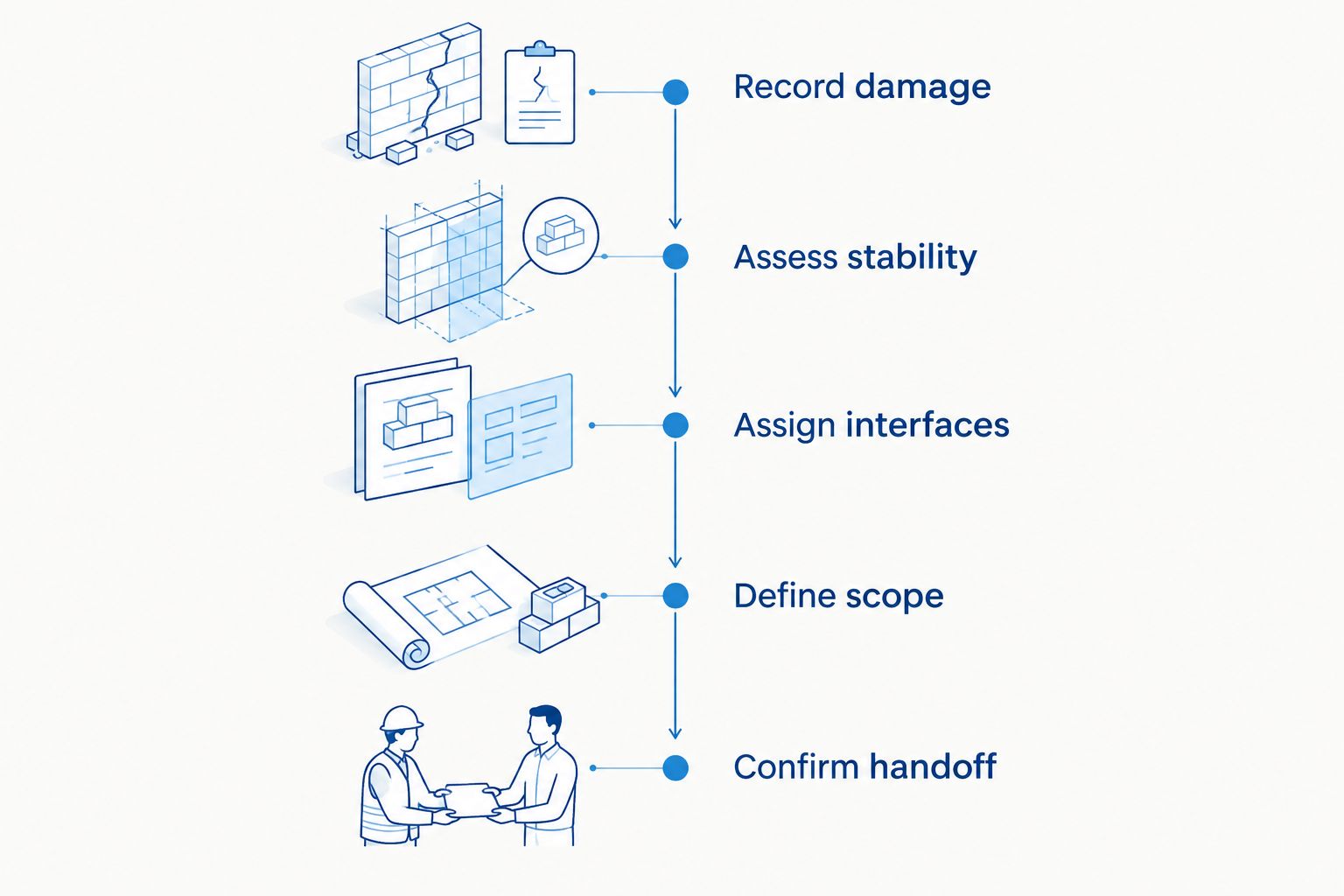
Use the following sequence for your 2026 chimney repair package. It turns an inspection into a scope that the masonry subcontractor, roofer, and general contractor can each act on.
Record damage
Document the damaged areas with photographs and location notes. Include joint loss, broken brick faces, cracks, visible displacement, crown condition, and staining without treating any single observation as a complete diagnosis.
Give the subcontractor the project context as well. State whether the chimney is part of an occupied building, a remodel, or work tied to a fireplace project, and identify finishes or spaces that need protection.
Assess stability
Ask which masonry is suitable to remain and which must be removed. The answer should identify the affected section and the reason for the recommendation, not simply label the entire chimney good or bad.
If the inspection cannot establish the condition of a concealed area, define the next assessment step. Do not turn an unresolved condition into an assumed repair quantity.
Assign interfaces
Name the party responsible for roofing, flashing, flue assessment, and any related fireplace work. Coordination means each trade understands the limits of its work and the condition required before the next trade starts.
For chimney work paired with a stone veneer fireplace project, separate the finish scope from chimney-system questions. A completed surround does not resolve an exterior masonry defect or establish safe operation.
Define scope
Write down repair areas, demolition limits, materials, protection, cleanup, and the process for approving additional work. Describe the intended finish without promising an exact visual match to weathered existing masonry.
Require the subcontractor to explain exclusions. A clear exclusion lets you assign the work; an unstated exclusion becomes a project dispute.
Confirm handoff
Agree on the inspection and walkthrough points before work begins. At completion, compare the finished work with the agreed scope and confirm which related tasks remain with other trades.
Keep photographs of exposed conditions and completed work with the project record. Those records help distinguish what was repaired from what was inspected and left in place.
Masonryspokane offers chimney masonry repairs and mortar restoration, with an emphasis on clear scope and coordination with other trades. Masonryspokane is a fit for builders seeking a Spokane masonry subcontractor for chimney repairs and mortar restoration. Request a free estimate or project-scope discussion that identifies retained masonry, repair boundaries, and trade responsibilities.
Discuss your chimney repair scope
Request a free estimate and discuss masonry condition, repair boundaries, and trade coordination.
Can tuck-pointing fix a chimney with damaged bricks?
Tuck-pointing does not repair the body of a damaged brick. Joint restoration addresses mortar deterioration; cracked, loose, or spalled units require their own assessment and repair scope.
For bid review, require separate descriptions of joint work and brick replacement. Otherwise, a proposal for fresh mortar can be mistaken for a proposal that resolves all visible masonry damage.
Does a chimney leak mean the whole chimney needs rebuilding?
A chimney leak alone does not establish that the whole chimney needs rebuilding. The inspection needs to identify the water-entry path and determine whether the affected masonry remains suitable to retain.
Roof flashing, the crown, mortar joints, and chimney-system components require distinct assessment. Assign the correction to the relevant trade rather than making rebuilding the default response to a water stain.
FAQ
How do I know whether a Spokane chimney needs repair or rebuilding?
A Spokane chimney needs repair when damage is localized and the remaining masonry is stable; it needs rebuilding where failed masonry cannot remain. Have the inspection identify retained sections, removal limits, water-entry issues, and separate flue concerns.
Can a leaning chimney be fixed by replacing mortar?
Replacing mortar is not a substitute for assessing a leaning chimney's stability. Require a qualified assessment of the displaced construction before approving joint restoration or continued use.
Is partial chimney rebuilding better than a full rebuild?
Partial chimney rebuilding is appropriate when the retained masonry is confirmed suitable to remain. Full rebuilding is appropriate when the condition prevents a sound repair or transition to retained construction.
Does exterior chimney repair make the fireplace safe to use?
Exterior chimney repair does not establish that the fireplace or flue is safe to use. Keep operational assessment separate from the exterior masonry scope and resolve any safety concerns before use.
What should I include in a chimney repair bid request?
Include damage locations, assessment findings, repair boundaries, material requirements, access conditions, protection, and trade responsibilities. Ask each bidder to state exclusions and how additional deterioration will be documented and approved.
Should the roofer or mason handle chimney flashing?
Assign chimney flashing responsibility explicitly in the project scope rather than assuming either trade includes it. The roofer and masonry subcontractor need an agreed sequence and a clear handoff at the roof interface.
Can I get a free estimate for chimney masonry work?
Masonryspokane encourages a free estimate or project-scope discussion for masonry work. Bring photographs, project details, and any inspection findings so the discussion addresses repair boundaries and coordination.
One last thing
For your 2026 project handoff, ask a question that often gets lost in the repair description: What is being left in place, and why is it suitable to remain? The answer is the basis for choosing repair over rebuilding.
A bid can describe demolition clearly while saying almost nothing about the construction supporting the new work. Require both sides of that boundary to be documented before you authorize the scope.